Quiz 2 Review
The second quiz will cover Chapters 4-7, El Nino, climate change, and chapter 16. The format of the second quiz will be similar to the first. Below you will find a list of topics that we've covered (in varying levels of detail). As with the last quiz, the list below was compiled by Dolly Freidel. Her version of the class focused a bit more on weather and a bit less on climate than my class. Study accordingly. Below the list of concepts and terms you will find some sample questions.Concepts and Terms that may be on the exam
Air Pressure
High Pressure -- Sinking air, Associated with stable air, sunny skies (not necessarily warm temperatures)Low Pressure -- Rising air, Associated with unstable air, clouds, maybe precipitation
Cold air-- tends to be higher pressure, dense because cold
Warm air -- tends to be lower pressure, less dense because warm
Air pressure, Gravity -- highest pressure near sea level, air pressure decreases with altitude
Driving force: Pressure Gradient Force -- pulls air from High Pressure to Low Pressure
Driving force: Coriolis Force --bends air to right in the No. Hemisphere, to the left in So. Hemisphere, none at equator, strongest at poles, strongest at high velocities, none at zero velocity
Resisting force: Friction -- slows down surface winds
Cyclone: air circulating into a low pressure cell, counterclockwise in N. Hemisphere
Anticyclone: air circulating out of a high pressure cell, clockwise in N. Hemisphere
Global Atmospheric Circulation
Be able to draw globe showing winds and High/Low pressure cellsTropical Circulation (including ITCZ and Subtropical Highs)
Intertropical Convergence Zone(ITCZ) (low pressure, rising air, thunder storms)
Subtropical High Pressure Cells) (sinking air, hot deserts)
Polar Front (boundary between Subtropical Air and Polar Air)
Westerly winds, Polar Jet Stream, Westerly cyclonic storms, Cold fronts and Warm fronts
Polar Highs (Polar Easterly winds)
Jet streams
Polar front, polar jet stream -- located right above the polar front at the top of the troposphere, westerlySubtropical jet stream -- located right above the descending part of the Hadley cell, also westerly
Local Winds
Land-Sea breezesMountain-Valley breezes
Katabatic winds -- cold air drainage, very high winds, especially in Antarctica
Santa Ana winds -- Southern California, blowing down from the Great Basin in fall
Chinook winds -- warm winter winds off the Rockies, snow eaters, in western Great Plains
Monsoonal Winds, Monsoons -- as they affect seasonal precipitation
Where do monsoons occur? Why? What causes monsoons? (winter offshore dry, summer onshore wet)
Water on Earth
Hydrosphere -- Ocean CirculationWind driven surface ocean currents
Subtropical gyres --circulate around the Subtropical Highs; horse latitudes in the center, clockwise in N, counterclockwise in S (anticyclonic flow)
Warm and cold ocean currents
Gulf Stream -- carries warm water up to the North Atlantic, helps keep Europe warm
Cold water upwelling -- east sides of ocean basins, west sides of continents, at ~35oN&S Lat
Influence of Coriolis effect and winds
North Atlantic Deep Water -- ocean deep water circulation, also called "thermohaline" circulation (thermo=heat, or in this case cold; haline=salty or saline)
Potential effects of shutting down of thermohaline circulation
Hydrologic Cycle
How much water is in the system, and where is it? proportions of salt water with fresh, where most is located, storedUnique properties of water: solid, liquid, gas, phase changes
Latent heat -- stored during vaporization, released during condensation
Sensible heat -- heat you can feel or measure with a thermometer
Relative humidity, percentage of actual water vapor in air relative to vapor content at saturation
Dew point temperature
Adiabatic processes
Environmental lapse rate -- Actual change in temperature with elevationAverage lapse rate in atmosphere -- 6.4 deg C/1000 m, or 3.5 deg F/1000 ft
Dry adiabatic lapse rate -- 10 degrees C per 1000 meters, in UnSaturated AIR, no condensation!
Wet or Moist adiabatic lapse rate -- varies with water vapor content (temperature at saturation), between 4 and 9 deg C/1000 m, avg. 5 deg. C/1000 m -- latent heat released during condensation slows rate of cooling, so air cools more slowly with elevation than when air is not saturated
Air parcel cools adiabatically when rising, warms adiabatically when sinking (at dry ALR)
Temperature inversion -- when layer of warm air overlies cold surface air
Condensation, clouds, and fog
Condensation nuclei -- aerosols, dust particles onto which water condenses into dropletsDew and frost -- do not fall, so NOT precipitation, caused by longwave radiation leaving surfaces at night
Radiation fog, advection fog, upslope fog
Cloud classification
By vertical development: stratus and cumulusStratus clouds are caused by evenly rising air over a large area -- flat lying layers
Cumulus clouds are caused by uneven, turbulent rising and sinking air -- piled up, convective
By elevation: cirrus, alto, etc.
Also nimbus, cumulonimbus, lenticular clouds, and other interesting types
What do different clouds tell you about weather (e.g. fronts approaching)?
Precipitation
Requires mechanism for uplift, cool to dew point temperatureRequires also condensation nucleii, dust, salt crystals suspended in air
Four Mechanisms of Uplift -- (1) convective, (2) orographic, (3) frontal, (4) convergent
(Be able to draw diagrams and describe mechanisms of uplift)
Formation of Clouds and Precipitation
Stable and Unstable Atmospheric Conditions
Rising air associated with unstable conditionsRising air cools because of expansion, resulting from lower air pressure
Unstable -- rising air, moisture condensation, clouds, possible precipitation
Sinking air associated with stable conditions
Sinking air warms through compression, a result of moving down to higher air pressure
Stable -- sinking air, water droplets evaporate, dry conditions, no clouds
Weather
Orographic precipitation, rainshadow effect (why?)Warm fronts and Cold fronts -- be able to draw cross-sections and describe associated weather
Midlatitude Cyclonic storms -- how and where they form, life cycle, role of air masses, Polar Front, Westerlies, Jet Stream
Weather associated with midlatitude wave cyclone
Thunderstorms and associated hazards -- hail, lightning, downbursts, intense rainfall (flooding), tornadoes
Tornadoes -- conditions for development, role of air masses, wind shear
Hurricanes -- (briefly) hazards of high winds, high tides, floods, intense rain, tornadoes,
What drives hurricanes? what conditions are necessary for development? Needs deep layer of very warm ocean water (warmer than 80 deg. F), Coriolis force, weak upper level winds (e.g. weak tropical jet stream)
Climate
What is climate? Average weather over 30 years of recordClimate Distribution: Understand relationship between climate at a particular place and:
Latitude -- solar radiation receipts
General Atmospheric circulation patterns, Hadley cell, ITCZ, winds
Semipermanent highs and lows
Wind patterns -- Trade winds, Westerlies, Polar Easterlies
Typical storms -- e.g. westerly cyclones, hurricanes, tornadoes, etc.
Distance from ocean -- (land-sea differences) continental and maritime influence
Ocean currents -- e.g. cold water upwelling, warm Gulf Stream
Air masses -- source, temperature, moisture characteristics
Topography and Relief -- e.g. elevation, location of mountains, aspect
Climate characteristics
Temperatures: mean annual, seasonal range, diurnal range (night vs day)Precipitation: sources, seasonality, frequency, intensity, type (rain, snow), cloudiness
Where are there areas that are humid year round, where are there deserts, where is it warm year round, where is it cold?
Natural climate variation
How has temperature changed on interannual timescales, over this century, Little Ice Age, Medieval warm periodPresent interglacial -- the Holocene, last 10,000 years
The Pleistocene, ice ages, last ~2.5 million years, why?
Great ice sheets over northern hemisphere, Canada, Europe, sea level drops
Global Warming
What is causing it?How have humans influenced it?
What are some of the consequences of it for future climate? For future human societies?
Acknowledgements
The list of review topics was compiled by Dolly Freidel.Sample Questions
-
In a low pressure weather system, what balance of forces controls the motion of air close to the surface?
- Pressure gradient and friction
- Pressure gradient, friction, and coriolis
- Pressure gradient and Coriolis
-
Why are low pressure systems associated with rainy weather?
- air is rising and moisture is condensing out of it
- air is descending and getting warmer
- the low pressure is caused by the rain
-
How do global wind patterns affect ocean currents? (Circle all true statements)
- They don't affect the currents
- They create clockwise circulations in the nothern hemisphere's ocean basins and counterclockwise circulations in the souther hemisphere.
- They cause upwelling off the west coasts of continents.
- The air motion makes the water blue.
-
The intertropical convergence zone (ITCZ) is a zone of ____. (Circle all true statements).
- converging air
- high precipitation
- rising air
- low albedo
- high solar radiation at the top of the atmosphere
-
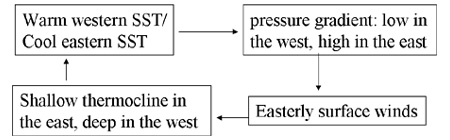
The Bjerknes feedback describes the El Niño/Southern Oscillation system. Use it to explain what happens during an El Niño. It is easiest if you start with the winds.
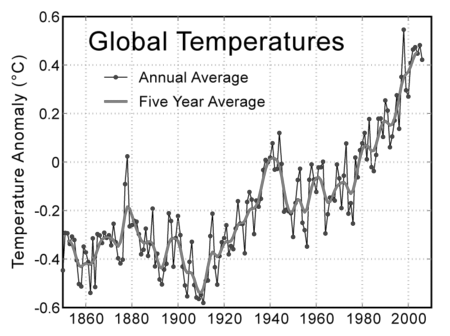
- Climatologists define anomalies as anomaly = data - average of 30 years' data. The next question's graph shows temperature anomalies relative to 1961-1990. If the global mean temperature for 1961-1990 was 14 degrees Celcius, what was the global mean temperature for the most recent year shown?
-
The following graph shows scientists' best estimate of global surface temperatures for the last 150 years. Explain the major features of the graph. Include the reason for the general upward trend, the flattening between 1940 and 1975, and the interannual variability around the 5-year average.
-
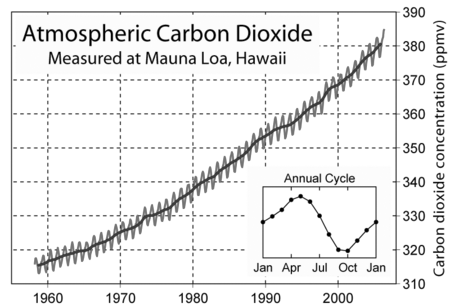
Measurements of carbon dioxide taken at Mauna Loa have been going up over the last 50 years. Why? Why is there an annual cycle in the CO2 in the atmosphere?
-
For the last million years, the Earth's climate has gone through large fluctuations with a period of about 100,000 years. What happens during these cycles?
- Glaciers expand over most of Canada and the northern USA before retreating.
- Carbon dioxide levels in the atmosphere are highly correlated with temperatures.
- Trees migrated across large distances to stay in their preferred climate zone.
- Sea level was lower because so much ice was trapped on land